
Criminal Court Cases in Monterey County
The Superior Court of California, County of Monterey criminal clerk holds the case files for both felonies and misdemeanors. California places this trial work in superior court rather than splitting it between separate felony and misdemeanor courts. The clerk processes complaints filed by the District Attorney, City Attorney, or another prosecutor, sets appearances, accepts later case documents, searches records, and prepares certified copies.
A court case begins after a prosecutor files a complaint or another charging document. It is distinct from an arrest or jail booking. The Monterey County file can show which counts were filed, how the accused pleaded, what the judge ordered, and whether each charge ended in conviction, dismissal, or acquittal. For the earlier booking side of an event, the county's arrest search channels serve a different purpose.
Monterey County Criminal Records Desk
The Salinas Courthouse at 240 Church Street, Salinas, CA 93901, is the practical hub for Monterey County criminal court records. Its clerk counter handles record searches, file viewing, copies, certified copies, and retrieval of older case files. The courthouse phone is (831) 775-5400, and public hours are Monday through Friday from 8:00 a.m. to 4:00 p.m.
The court has other regional access points. Monterey Courthouse is at 1200 Aguajito Road, Monterey; Marina Courthouse is at 3180 Del Monte Boulevard, Marina; and King City Courthouse is at 250 Franciscan Way, King City. Juvenile justice sessions take place at 1422 Natividad Road, but legal documents remain filed and maintained at the Salinas Courthouse. That split matters because juvenile files also face tighter access rules.
The court's criminal records instructions show the official request paths. The image below preserves that office's own explanation of court record access.
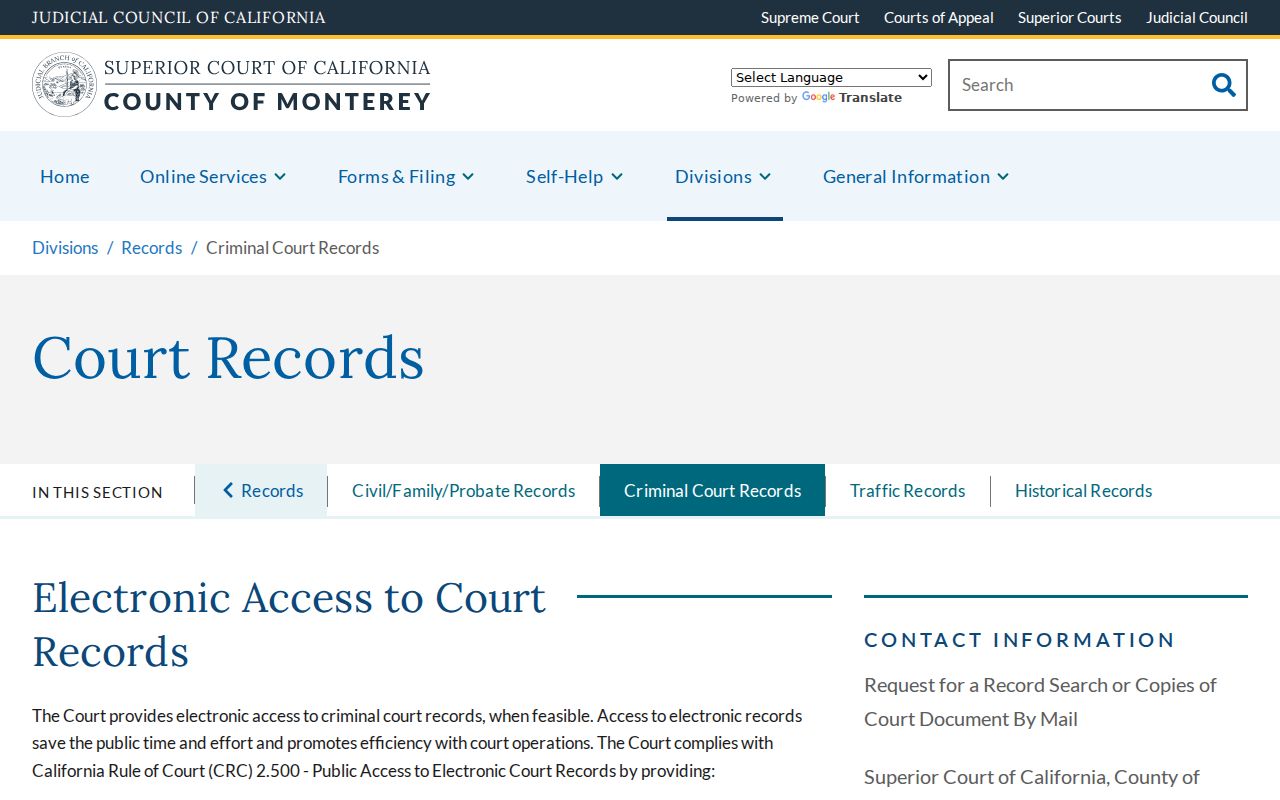
It helps separate online case information from the copies and certified documents that only the clerk supplies.
Monterey County Case Record Searches
The court's case-search page routes users to the free Public Portal and says no registration is required. Use a case number when one is known. It is the cleanest way to avoid a false match among people with similar names. A party-name search is the next route, while the register of actions and hearing details help confirm that the result is the right Monterey County case.
- Open the Monterey Superior Court Public Portal and choose Case Search.
- Enter the case number when available, or search by party name.
- Compare the case type, filing date, court location, and status before relying on a match.
- Read the register of actions, hearing entries, charges, pleas, and disposition as separate parts of the file.
- Request a plain or certified copy from the clerk by mail or in person when the portal result is not enough.
| Portal field | Type | Required | Use |
|---|---|---|---|
| Quick Search / Case Search | Search tile or link | No | Opens the portal's case-search route. |
| Case Number | Text | Not stated | Best exact path and helps avoid a clerk search fee. |
| Party Name | Text | Not stated | Finds records when the case number is unknown. |
| Search / Submit | Button | Not applicable | Runs the query on the selected portal screen. |
| Reset / Clear | Button | Not applicable | Removes prior search values when shown. |
Monterey County Portal Date Limits
Two official date statements describe different layers of Monterey County case access. The self-service portal covers current and completed cases dating back to 2008. The criminal records office says electronic criminal information extends from November 1992 through the present. These claims are not interchangeable. The first describes the public portal, while the second describes the deeper electronic information available through the clerk and courthouse.
For a violation date before November 1992, use the clerk counter or submit the court's record search and copy form. Public computers in the Clerk's Office can display indexes, calendars, registers of actions, and case information under California's courthouse-access rules. A portal search with no result therefore does not prove that no Monterey County case exists.
The criminal clerk's office page shows the work handled at the counter. This official view helps explain why a direct clerk request remains part of a sound search.
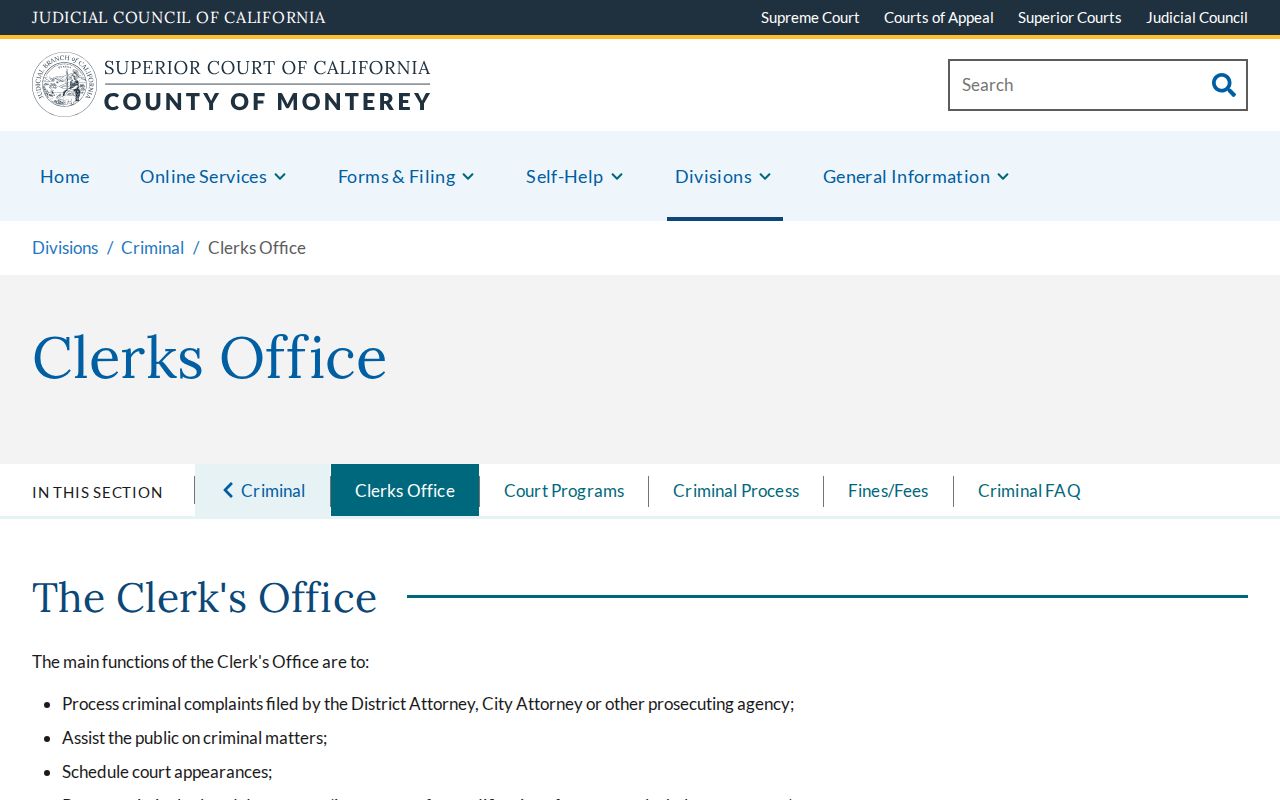
The clerk route is vital for older matters, document copies, and records whose remote display is limited.
Note: Phone searches are not offered, so use the portal, a mailed CR-109 request, or the public counter.
What a Criminal Case File Contains
A Monterey County criminal case file is organized around one prosecution. The header and register of actions tie the case number to its court, parties, filed counts, events, and outcome. Read each count on its own. One charge may be dismissed while another produces a plea or judgment, so a case-level label can hide an important difference.
| Case Number and Court | Identifies the file, location, department, case type, and filing date. |
|---|---|
| Charging Document | Shows the complaint or later accusation, counts, statutes, and filed classifications. |
| Docket Entries | Lists filings, minute orders, hearings, motions, pleas, and other case events. |
| Hearing Dates | Shows scheduled or completed appearances and the next event when one is set. |
| Disposition and Judgment | Records the result for a charge, such as conviction, dismissal, or acquittal. |
| Sentence and Conditions | May show jail or prison terms, probation, fines, restitution, and later relief orders. |
A post-conviction petition can add later entries. Relief under Penal Code sections 1203.4 or 1203.4a appears as a dismissal notation; it does not erase or seal every court, police, motor vehicle, or California DOJ record.
Monterey County CR-109 Copies
Use form CR-109 when a portal check does not supply the needed record or when copies must come by mail. The form asks for the name to be searched and can take a birth date, driver's license number, filing or disposition date, and an approximate filing period. It also lets the requester name the documents, choose certification, and select mail, pickup, or wait options.
The clerk charges $15 for each name searched, 50 cents per copied page, $40 to certify each document, and $10 when a file must be retrieved off site. A mailed request needs a self-addressed stamped envelope. Payment may be made by check or money order, not cash through the mail. If the final amount is unknown, the court permits a check marked “not to exceed $200.”
Up to three on-site files may be retrieved the same day. More than three searches, or off-site files, can take up to 72 hours. Mailed copies need at least ten days. These are service windows, not promises that a Monterey County case will contain every document sought.
Criminal Case Stages in Monterey County
The Monterey County District Attorney reviews a law-enforcement referral and decides whether to file a complaint. Once filed, the clerk opens the Superior Court case and places the arraignment and later events in the register of actions. Pretrial motions or negotiations can change the counts before a plea or trial. The final stage records the outcome and, after conviction, the sentence.
Case flow: Charges Filed → Arraignment → Pretrial → Plea or Trial → Disposition → Sentencing
Each point can leave a distinct Monterey County court record. A complaint states allegations, an arraignment records the plea, minute orders summarize hearings, and the disposition states how a count ended. Sentence entries may include probation, custody, fines, or restitution. The sequence matters more than any one early entry.
Reading Monterey County Docket Terms
The register of actions is the court's event list, not a single verdict sheet. Its short labels can be hard to read without context. These terms cover the entries most likely to answer a Monterey County case question.
- Arraignment
- The first court appearance for advisement and a plea.
- Minute order
- The clerk's official summary of what occurred at a hearing.
- Disposition
- The outcome of a charge or the case, including conviction, dismissal, or acquittal.
- Diversion
- A program that may pause or redirect prosecution while conditions are completed.
- Dismissal relief
- The more exact label for Penal Code section 1203.4 relief because the record is not erased.
Check the plea and disposition for each count, then read later minute orders and sentence entries. A filed felony can later end as a misdemeanor, and an initial allegation can be dismissed. That is why the complete Monterey County event history is more useful than the charge list alone.
Monterey County Collaborative Court Entries
Some Monterey County dockets do not follow a short plea-and-sentence line. The District Attorney's program list names Creating New Choices, Drug Treatment Court, DUI Court, Mental Health Court, Military/Veterans Diversion Court, and Truancy Abatement. Program participation can add reviews, treatment milestones, compliance hearings, or a later disposition to the register of actions.
Those events should not be read as new arrests. They are court activity within the filed Monterey County case. A docket may show repeated status hearings while a person works through a court plan, then show a later ruling based on completion or noncompliance. The image from the California Courts rule 2.503 page also reflects the statewide rules that shape remote criminal record access.
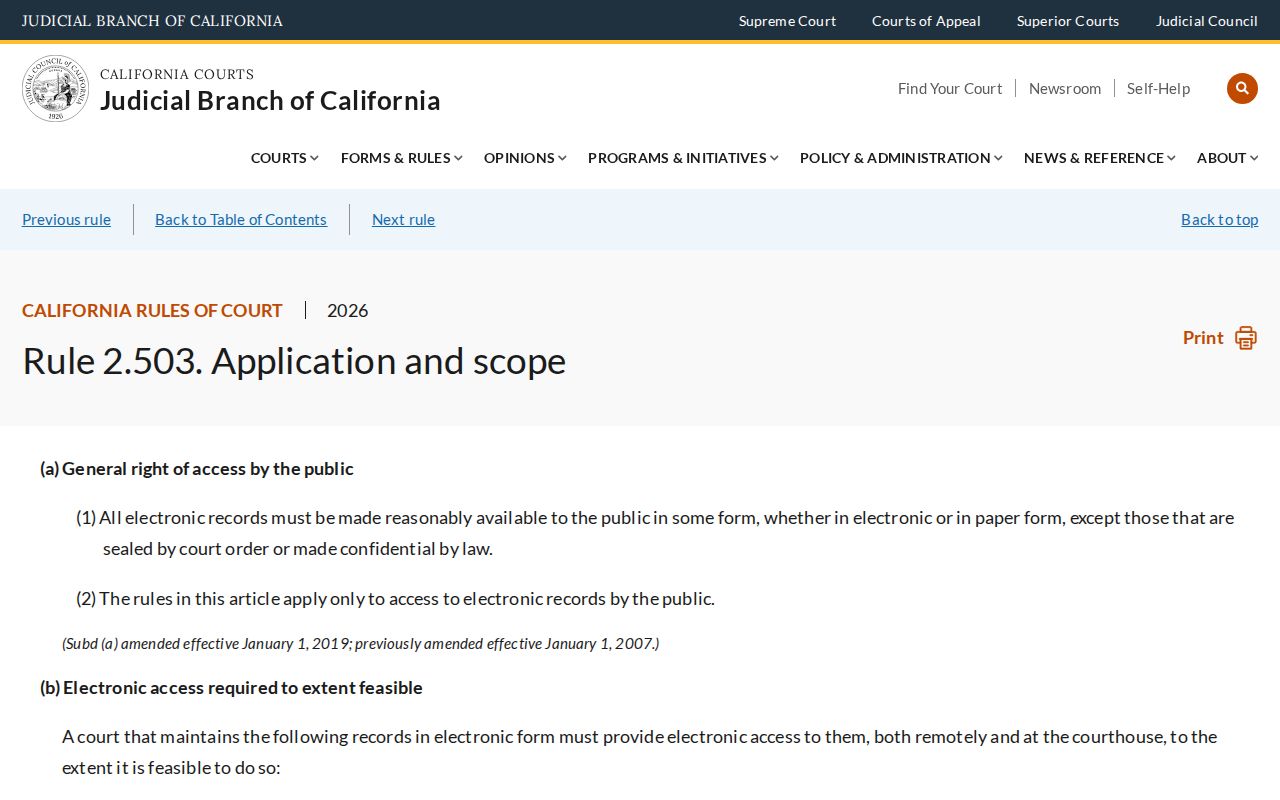
Program details may therefore be clearer in minute orders or the courthouse file than in the public portal summary.
Access Rules for Case Records
California Rules of Court rule 2.503 limits remote electronic access to criminal records even when public inspection is allowed at the courthouse. Online results may give case information without displaying every filed document. The clerk can explain whether a public copy is available, but confidential victim facts, private identifiers, active investigative material, sealed information, and juvenile records may be withheld or redacted.
The California Public Records Act governs many local agency records, while court-file access also follows court rules and judicial-record law. California DOJ summary criminal history is a separate system under Penal Code section 11105. It is not an open public name-search substitute for a Monterey County court lookup.
The official California law page provides the source text for the Public Records Act. Its captured view connects the general disclosure rule with the exceptions a records custodian must apply.
For a reliable result, verify a portal entry against the clerk's record when identity, charge outcome, or sentence details remain unclear.