
Monterey County Criminal History Checks
No single Monterey County criminal history database contains every local and state record. Begin with the Monterey Superior Court Public Portal when a filed criminal case is the goal. Use the Sheriff's in-custody log for present county jail status, the arresting police agency for its report, and California Department of Justice Record Review for your own statewide record. This division matters. A booking entry records jail intake, while a court file records charges, hearings, and the outcome.
Gather a full legal name, prior names, date of birth, approximate incident year, and case or booking number when known. Similar names can produce the wrong match. The court's CR-109 request also accepts a driver's license number, violation location, violation date, and a year range to help the clerk identify the right file. Verify identity through more than one nonprivate field before relying on a result.
- Choose the record type before searching: court case, police report, jail booking, state history, prison custody, or registry entry.
- Try the official online channel and match the result with the name, birth data, case number, agency, and date available.
- Move to the creating agency when the online window is too short or the record predates portal coverage.
- Read the disposition in the court file before drawing a conclusion from an arrest or booking entry.
- Order a certified court copy or fingerprint-based personal review when an official record is needed.
Four Monterey County Record Homes
Monterey County criminal records can live in four distinct systems. The police or sheriff report describes the event investigated. The county jail booking file documents intake and custody. The Superior Court case file begins only if a prosecutor files charges. A California DOJ summary history is fingerprint based and combines reportable events received from agencies and courts across the state.
| Record | Official custodian | Best use |
|---|---|---|
| Incident or arrest report | Sheriff or city police | Agency narrative and report details |
| Booking record | Monterey County Sheriff's Records | Jail intake and current custody |
| Criminal case | Monterey Superior Court | Filed charges, hearings, disposition, sentence |
| State summary history | California Department of Justice | Fingerprint-based review of your own statewide record |
Searching more than one official source resolves common gaps. An arrest may never become a filed case, and a court dismissal does not erase every law enforcement or DOJ entry.
Official Background Checks in California
The California Department of Justice Record Review is the route for a person to inspect their own state summary criminal history. California does not offer a public DOJ name search. The applicant completes form BCIA 8016RR, selects record review as the application type, and submits fingerprints through Live Scan. People outside California may use fingerprint cards under DOJ instructions.
The DOJ processing fee is $25, apart from the Live Scan operator's rolling fee. A fee-waiver process exists for eligible applicants. Monterey Police offers local Live Scan appointments and ink fingerprint cards, while the DOJ location finder lists other approved sites. This official process is for self-review and other uses authorized by law.
Monterey Court Portal Coverage
The Superior Court's case-search explanation says its self-service portal covers current and completed cases dating to 2008. No registration is required. Users can see case information and scheduled hearings, and some criminal or traffic balances can be paid online. The criminal records office separately states that electronic criminal information extends back to November 1992.
Those dates describe different access layers. Treat 2008 as the public portal's stated coverage and November 1992 as the clerk's electronic criminal information range. Older matters and documents still require the clerk, a public terminal, or the CR-109 request process. Phone record searches are not offered.
The manifest's Superior Court case-search source shows the official route described here.
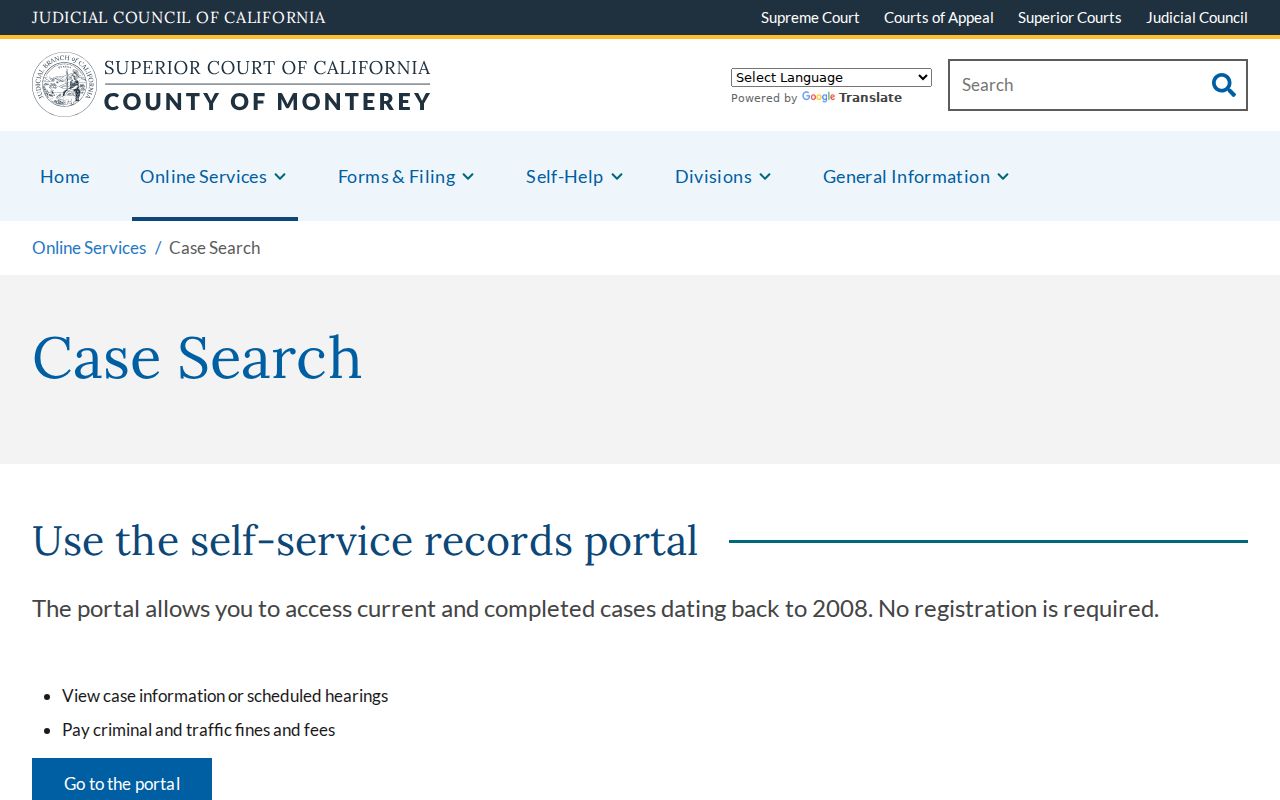
The captured page helps distinguish quick portal access from a clerk request for older or certified material.
Kinds of Criminal Records
A Monterey County criminal record is not one document. Each office records a different point in the process, and the legal meaning changes as a matter moves from investigation to final disposition. The agency that made the record remains the best source for a full copy or correction.
The Superior Court is the decisive source for whether a charge was filed and how it ended. Sheriff's records answer local booking and jail questions. City police departments retain their own reports. Probation records concern county community supervision, while CDCR records cover state prison custody and parole supervision.
- Arrest and booking records show an agency action and jail intake, not guilt.
- Criminal court files show complaints, hearings, pleas, orders, and outcomes.
- DOJ history compiles reportable fingerprint-linked events for authorized access.
- Warrants may arise from an arrest order or a missed court duty.
- Supervision and registry records concern probation, parole, prison custody, or registration duties.
Monterey County Custody Searches
Custody searches split across three levels. The Monterey County Sheriff's in-custody log covers people currently held in county jail and displays booking number, name, date of birth, sex, age, housing, agency, and charges. The CDCR Incarcerated Records and Information Search covers state prison custody. The federal Bureau of Prisons locator covers federal inmates from 1982 forward.
The CDCR CIRIS source in the image manifest represents the state layer.
Someone missing from one system may simply be housed at another level, released, or outside the public coverage period.
The Monterey County Sheriff mobile app also advertises inmate-search support. Its store listing was updated in February 2026. Use the official county log and jail phone for confirmation because app and web data can change at different times.
Monterey County Criminal Records: What They Contain
Content depends on the source. A DOJ record can contain identifiers, arrest cycles, agencies, booking numbers, charges, dispositions, and sentence data reported to the repository. A Monterey court file is case based. It can show filings, register-of-actions events, hearings, disposition, sentence, fines, and later petitions. A jail record is custody based and focuses on the booking and current housing.
| Name & Identifiers | Name, birth data, and other identifying details available under the source's access rules. |
|---|---|
| Arrest / Booking Data | Arresting agency, date, booking number, alleged charges, and jail housing where published. |
| Charges & Statutes | The alleged offense text and California code section. |
| Disposition | The outcome for each count, such as conviction, dismissal, or acquittal. |
| Sentence | Custody, probation, fines, restitution, programs, or other court orders. |
| Custody / Supervision | County jail, state prison, probation, or parole status when that system makes it public. |
Monterey County Logs Compared
The Sheriff's daily patrol log and in-custody log answer different questions. The patrol log covers the last three days of calls and is unavailable between midnight and 7:00 a.m. It can show a report number, date, time, charges, location, and officer. The in-custody table concerns current jail custody. Salinas Police uses a separate daily patrol log with a seven-day window.
When a log no longer shows the event, use the relevant agency's records process. Sheriff's requests go through Records or NextRequest. Salinas and Seaside use their city NextRequest portals, while Monterey Police accepts its report-release application. A later court filing appears through Monterey Superior Court.
The manifest's Sheriff NextRequest source illustrates the request fallback.
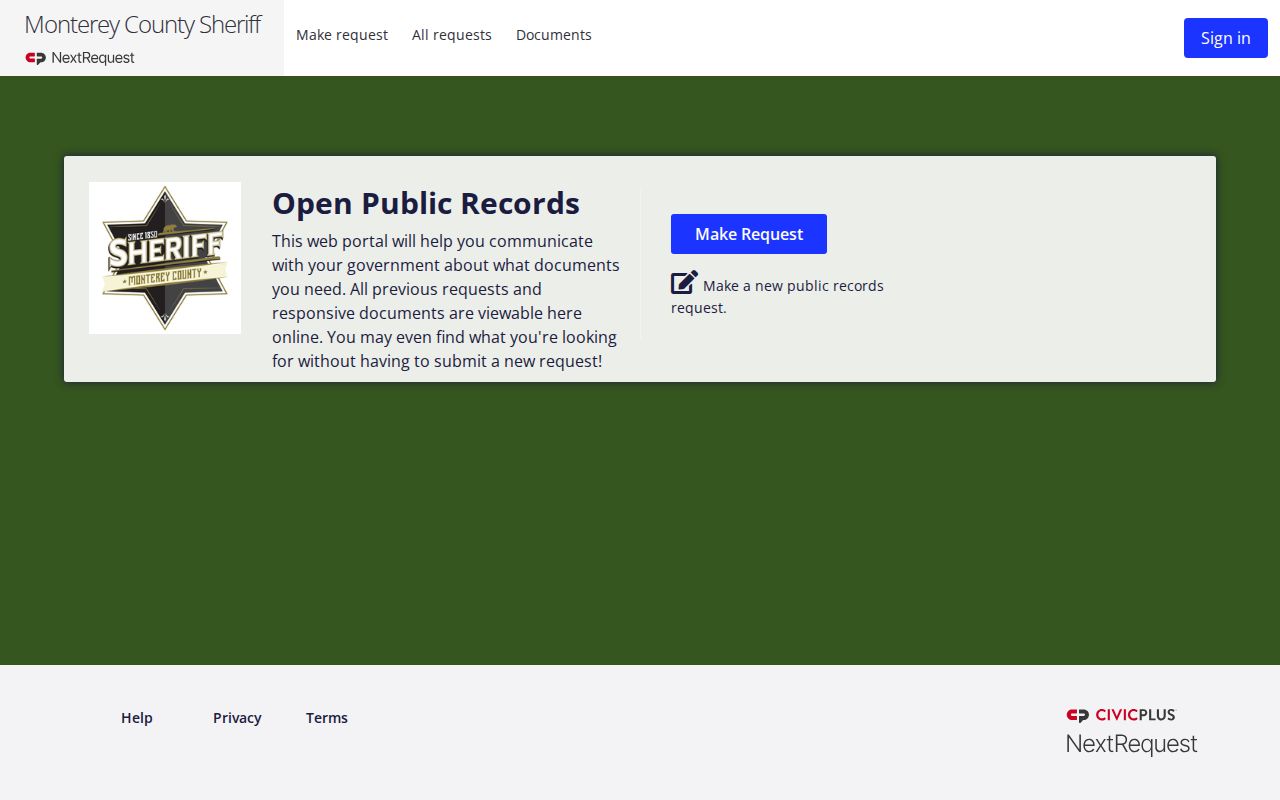
A public request can reach older agency records that no longer fit a short online log window, subject to lawful exemptions and redactions.
California Public Access Laws
The California Public Records Act generally opens local agency records unless an exemption applies. That does not turn DOJ summary history into a public name database. Court remote-access rules also limit what criminal material appears online, even when a record can be inspected through the clerk. Juvenile files, victim details, private identifiers, active investigations, and sealed matters may be withheld or redacted.
Key Statutes:
California Public Records Act - local records are generally open unless an exemption controls.
Penal Code section 11105 - DOJ summary criminal history is disseminated only under statutory authority.
California Rule of Court 2.503 - remote criminal court access is narrower than courthouse access.
Penal Code sections 1203.4 and 851.8 - California provides distinct dismissal and factual-innocence sealing remedies.
Monterey County Records Fees
Cost depends on the product and custodian. The Sheriff's Records Division lists a $92 local arrest-record check, which is local in scope and requires identification. Court CR-109 requests use a separate fee schedule. DOJ charges its own processing fee, and Live Scan operators add rolling fees.
| Service | Researched amount |
|---|---|
| Sheriff local arrest-record check | $92 |
| Court name search | $15 per name |
| Court copy | $0.50 per page |
| Court certification | $40 per document |
| Off-site court file retrieval | $10 |
| California DOJ Record Review processing | $25, plus rolling fee |
Mail court requests need a stamped return envelope. The court permits a check marked not to exceed $200 when the final copy cost is unknown, and it warns requesters not to send cash.
Restricted, Sealed & Expunged Records
Restricted Monterey County records include juvenile files, sealed matters, confidential victim information, private identifiers, active investigative material, and DOJ summary history outside lawful access. Agencies can redact protected details while releasing the rest. Juvenile sessions occur at the Juvenile Justice Court on Natividad Road, but filings are kept at the Salinas Courthouse under access rules that differ from adult cases.
California expungement commonly means dismissal relief under Penal Code section 1203.4 or 1203.4a. Monterey Superior Court states that this relief does not seal, destroy, or remove all court, police, DMV, or DOJ entries. The docket instead notes the relief, and the clerk reports the change where required. Factual-innocence relief under section 851.8 is a different path that can lead to sealing and later destruction of arrest records after the required finding.
The image manifest links to the DOJ record-review process, which is useful after an order when a person needs to inspect their own state record.
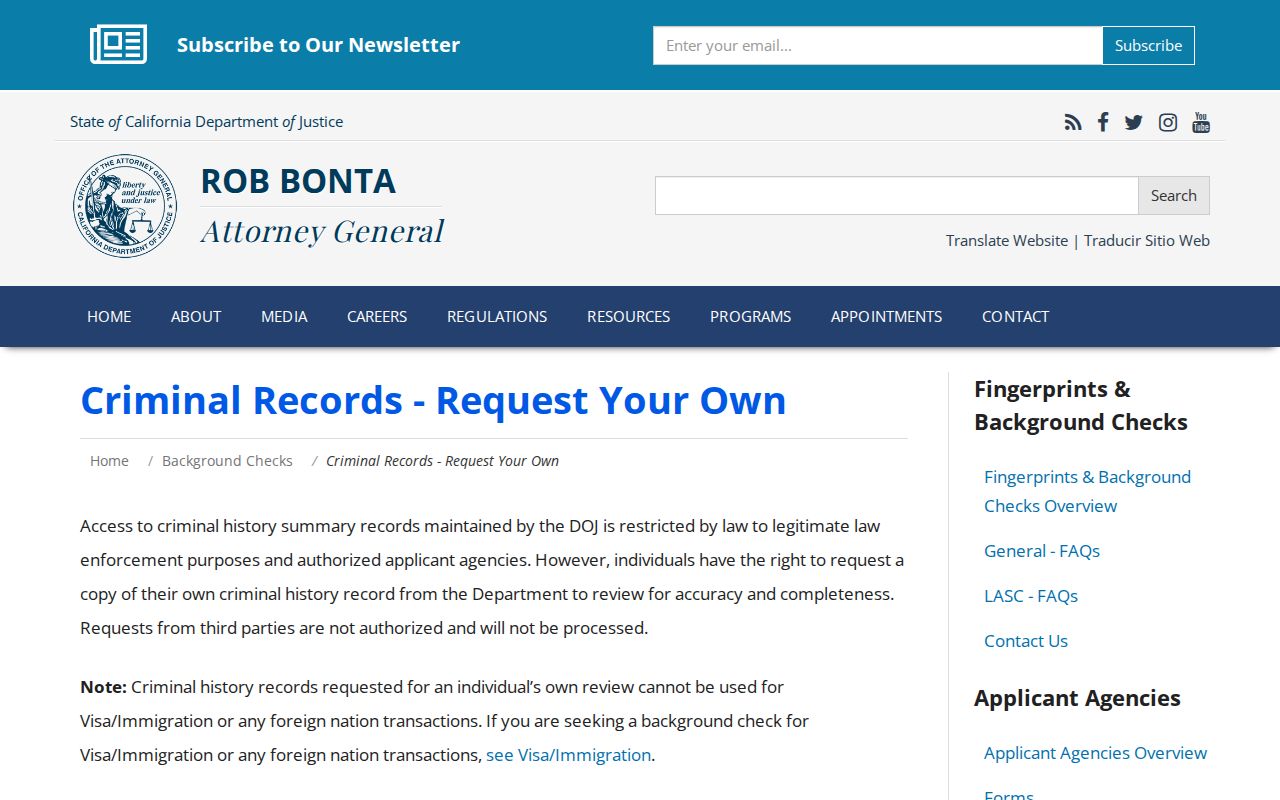
Reviewing the resulting DOJ response can reveal whether a court disposition or relief notation still needs correction through the reporting agency.
Monterey County Registry Search
The California Megan's Law Website is the official public registry search for Monterey County. It offers name and map-based tools for public safety and community awareness. Its display is not a full list of every person required to register because California law permits or requires different posting categories.
The manifest's Megan's Law source shows the statewide system used for a Monterey County sex offender lookup.
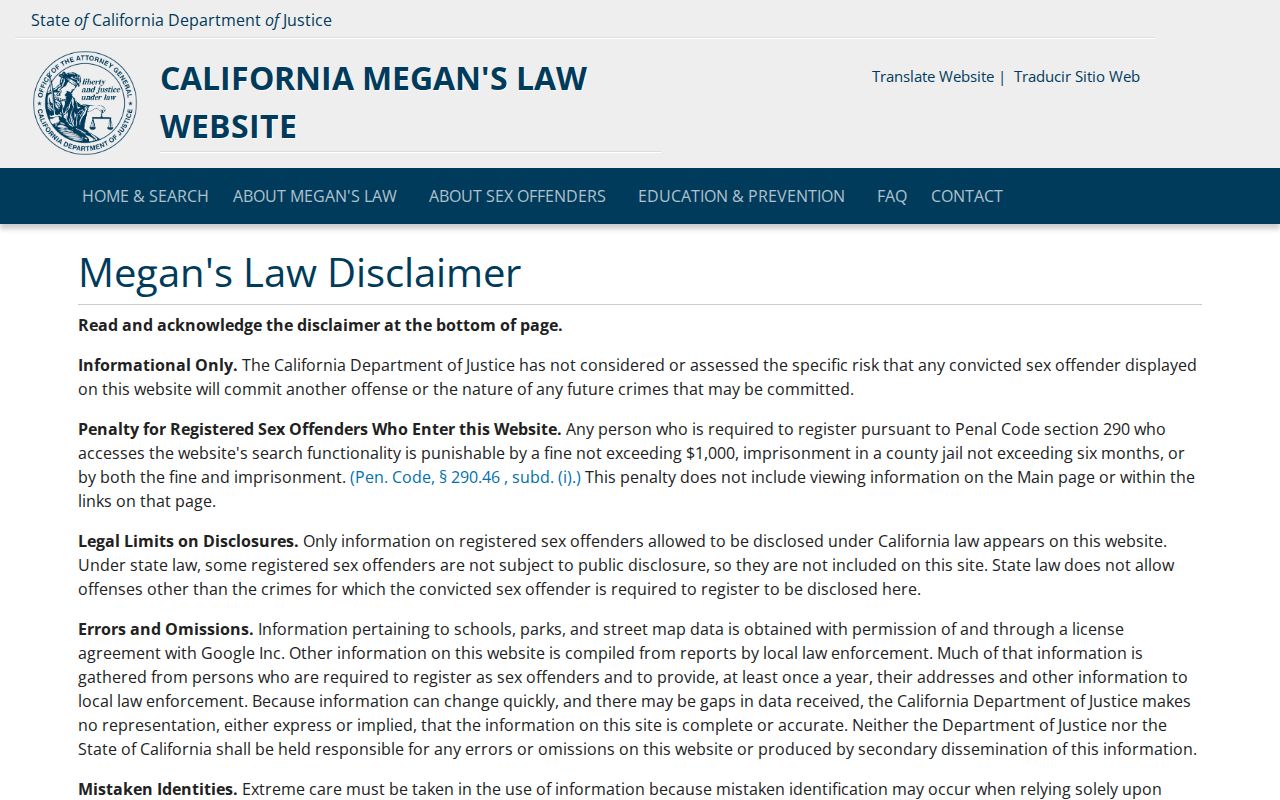
Confirm identity carefully and follow the site's disclaimer. Penal Code section 290.46 prohibits using registry data to harass or commit a crime.
Monterey County Warrants and Supervision
Monterey County has no confirmed single public warrant-name database. A bench warrant often follows a missed court appearance or violation of a court order, while an arrest warrant authorizes law enforcement to make an arrest. Start with the Superior Court case record when the warrant may come from a filed case. For a sheriff or city matter, contact the agency records channel. Someone resolving their own possible warrant should seek case-specific guidance before appearing at an office because an active order can lead to arrest.
Probation and parole also belong to different systems. Monterey County Probation supervises county cases in the community from its Adult Division at 20 E. Alisal Street in Salinas, with additional county office locations. Parole follows release from California state prison and falls under CDCR's Division of Adult Parole Operations, with parole decisions handled through the Board of Parole Hearings. A court docket may state that probation was ordered, but the supervision file is not the same as the public case file.
Monterey County collaborative courts add another local layer. The District Attorney identifies Drug Treatment Court, DUI Court, Mental Health Court, Military and Veterans Diversion Court, and Creating New Choices among local programs. Docket entries can therefore reflect treatment, review hearings, diversion, or a specialized calendar instead of a straight path from conviction to custody. The register of actions and minute orders provide the best context for those entries.
- Bench warrant
- A court order for arrest that often follows a missed appearance or failure to obey an order.
- Probation
- A county-supervised sentence served in the community under court-set terms.
- Parole
- State supervision after release from a California prison term.
- Diversion
- A program that can pause or redirect prosecution while a participant completes set conditions.
City-by-City Criminal Records in Monterey County
Salinas, Seaside, and Monterey police keep city reports through their own channels. Adult felony and misdemeanor cases route to Monterey Superior Court rather than separate municipal criminal courts, and county jail bookings remain with the Sheriff. Start with the city agency for a police report, then follow filed charges to the court and custody to the county jail.
Salinas Record Check
163,542 · Police NextRequest, seven-day patrol log, and the county's main courthouse.
Seaside Record Check
32,366 · City NextRequest and police records contact at Harcourt Avenue.
Monterey Record Check
30,218 · Police report applications, fingerprinting, and the Aguajito Road courthouse.
Monterey County Record Offices
Online tools are only the first layer. These offices handle record copies, older material, or questions that a short public display cannot answer.
Superior Court Clerk
240 Church St.
Salinas, CA 93901
(831) 775-5400
Sheriff's Records Division
1414 Natividad Rd.
Salinas, CA 93906
(831) 755-3700
Monterey County Probation
20 E. Alisal St.
Salinas, CA 93901
(831) 755-3910
Call before travel when a file may be off site. The criminal clerk may need up to 72 hours for more than three in-person searches or files stored elsewhere, while mailed copy requests should allow at least 10 days.
Monterey County Public Portal
The direct Superior Court Public Portal is the fastest official starting point for many current and completed cases. Search results can establish the case number, location, hearing schedule, and register of actions needed for a more precise clerk request.
The image manifest's Public Portal source depicts that official entry point.
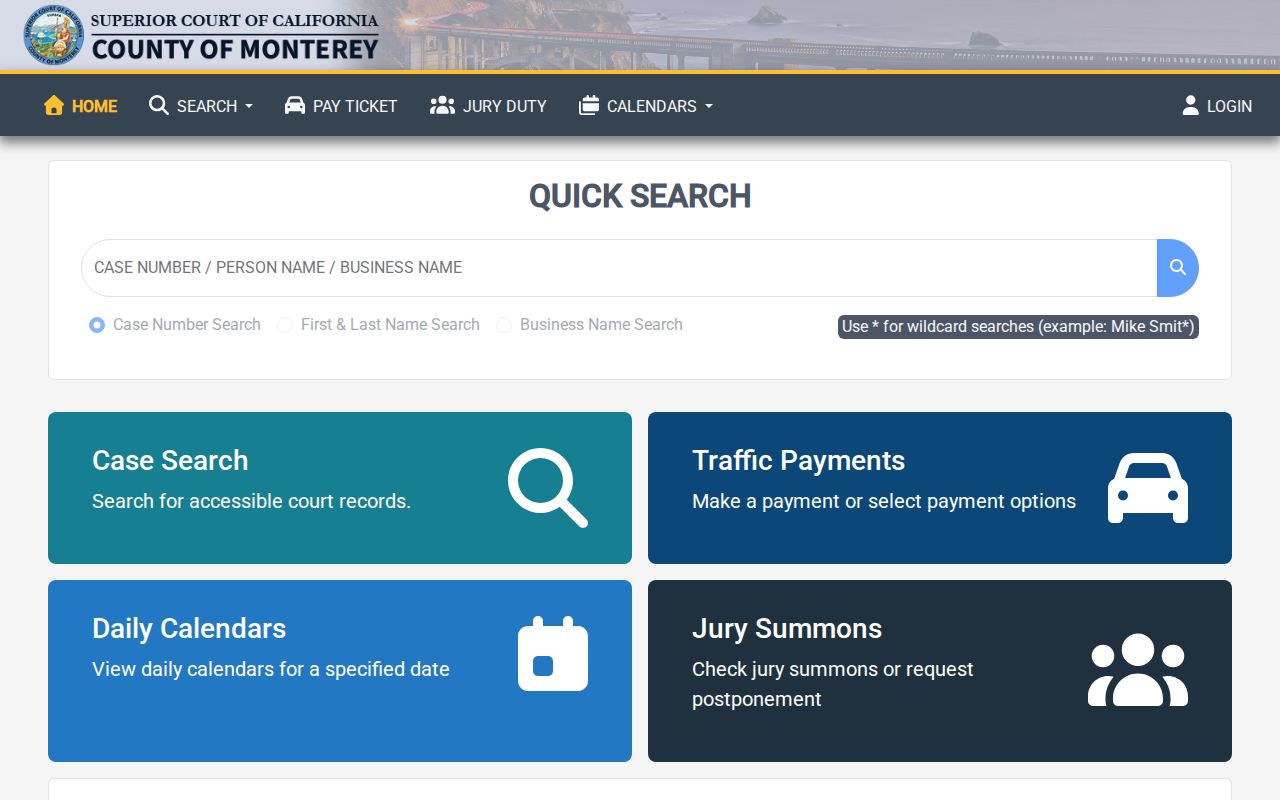
A portal result is not a certified case file. Request the underlying document from the clerk when the exact allegation, minute order, disposition, or sentence matters.